
Plum Previous Residents Sources
The source for a Plum address depends on its era and the question being asked. A deed can establish parties to a transfer and the land description. An estate can identify a decedent and representative. A census or an appropriately covering directory can place a household in a dated setting. Borough files can document work or a public action at an address. None of these sources is a complete list of everyone who lived there, so the records should be paired only where their dates and property references line up.
| Source | Years It Covers | Where Held | What It Shows |
|---|---|---|---|
| Allegheny deeds and index books | 1789 to present availability stated | Division of Real Estate | Title parties, legal descriptions, plans, and prior references; online image cutoff is not published |
| Estates and Estates Index | Estates 1789 to date; index 1788-1971 | Orphans' Court and Carnegie Library Pennsylvania Department | Decedent, personal representative, and estate history |
| Census material | Microfilm 1790-1920; released federal census through 1950 | Carnegie Library Pennsylvania Department and federal resources | Household or area snapshot, not a parcel record |
| Historic Pittsburgh directories | Principally 1815-1945 | University of Pittsburgh consortium collection | Names and addresses only where the selected volume covers the Plum vicinity |
| Plum permit or code files | Dates not published | Plum Borough | Address-based construction or inspection evidence by request |
| Regional historic maps | Individual years unverified | Historic Pittsburgh, Detre, or Library of Congress catalogs | Road, plan, and geographic context; no verified Plum Sanborn list |
Begin with the stable property trail when the time period is unknown. Then add household sources only after the deed, plan, and address details point to the same place. Note: A missing entry can reflect coverage, spelling, enumeration, or access limits instead of a proven gap in residence.
Build a Plum Previous Residents Address File
Start with the Allegheny County Real Estate Portal's current parcel record. Save the parcel ID or block-lot, situs address, municipality, owner of record, mailing address, sale date, recording date, deed book and page, plan reference, and legal description. This is an address file, not a conclusion about occupancy. The portal's previous-owner area shows only the current and two earlier owners, regardless of sale date, so it cannot replace a full chain of title.
The Allegheny County Real Estate Portal parcel card shows the kind of current record inventory used to anchor a backward search.
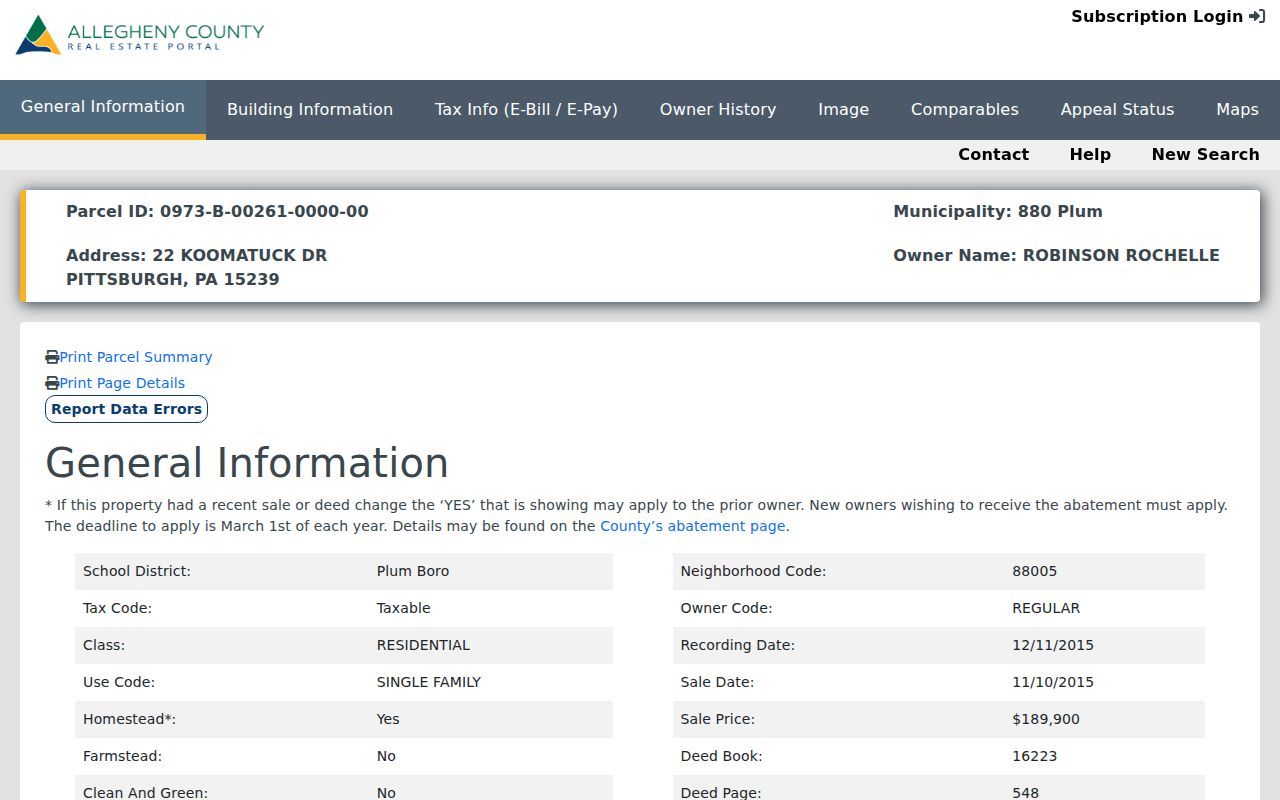
Use the assessment card to preserve identifiers and dates before moving to a deed. Its owner mailing field is where the assessment bill goes, not proof that a person lives at that site.
- Parcel ID, block-lot, street or situs address, and municipality
- Owner of record and separate owner mailing destination
- Sale date, recording date, sale price, deed book, and deed page
- Plan reference, legal description, lot area, and any linked map or image
- Building, tax, image, comparables, appeal-status, and map tabs as contextual leads
Trace a Plum Deed Chain
The Division of Real Estate holds the county land trail. Its Official Record Search offers quick and advanced searches with a Land Records department, a search term for grantor, grantee, subdivision, document type, or document number, recorded-date filters, index-only and index-plus-OCR modes, card view, and a cart. Start with the current deed reference and the seller named in that conveyance. The seller is a lead to search as an earlier grantee, not automatic proof of the next link.
| Department | Land Records on the inspected official search. |
|---|---|
| Search Term | Grantor or grantee, subdivision, document type, or document number. |
| Recorded Date | An optional from-and-to range with recent-period shortcuts. |
| Index Only | Searches indexed information; two or more words are searched individually. |
| Index and Full Text OCR | Searches a multiword entry as a phrase; historical OCR needs confirmation against the indexed result and image. |
- Open the current parcel record and retain its PIN, block-lot, legal description, deed book and page, plan reference, and dates.
- Obtain the cited deed from the Official Record Search or through the Division of Real Estate's copy route.
- Read the seller or grantor, buyer or grantee, legal description, and any prior-deed reference. Search the seller as an earlier grantee.
- Compare the lot, plan, legal description, and parcel details before accepting the next deed as the same property.
- Repeat backward. When the selected date or volume is not online, ask the Division whether the record is available through its counter terminal, index books, microfilm, or book consultation.
- Grantor and grantee
- The grantor transfers an interest in a deed; the grantee receives it.
- Chain of title
- The documented sequence of transfers for the same land, checked through the legal description and references.
- Legal description
- The lot and recorded plan, metes-and-bounds, or prior-deed language that identifies land more durably than a street address.
Note: Match the legal description and plan reference at each step because a similar street address or surname can create a false deed link.
Plum Address History Needs Old Media
Allegheny says deeds are available from 1789, but the access route changes with the record. Deed-index books remain at the Division of Real Estate. County history describes digitized images, microfilm, and books, and notes a scanning initiative for 1788 through 1880 deeds because original pages were deteriorating. Do not assume that a historic book is available as a free online image merely because a current search screen exists.
The county land-records hub describes online, counter, and mail copy paths. The Division's counter is in Room 101 of the County Office Building, 542 Forbes Avenue, Pittsburgh. Ask which medium serves the exact book and page, and ask the live office about current image or copy requirements before ordering. The useful question is not simply whether the deed is online, but where that volume can actually be examined.
For older property trails, the county genealogy page also points to estates from 1789 and the Carnegie Library Pennsylvania Department's Estates Index from 1788 through 1971. Estate material can clarify a decedent or representative, but it does not by itself prove that an heir lived at the address.
Plum Past Households in Directories
Title parties are only one layer of an address history. A directory can list a person or business at a stated address, while a census can place a household in an enumerated area. Historic Pittsburgh's digitized directory core is 1815 through 1945, but most volumes concern Pittsburgh and Allegheny City. Check the selected title's geographic coverage before tying it to Plum. A county library resource provides census microfilm from 1790 through 1920; released federal census records continue through 1950.
Pair the sources in time order: address file to deed, deed to a properly covering directory, directory to the nearest released census, then census or deed to estate and obituary material where the source supports the connection. Copy the directory year, title, publisher, page, and spelling. The historical collections and entry-reading checks are kept on the Plum city directory page.
A directory listing is evidence of that listing, not a count of every household member. A census is a dated snapshot rather than a parcel key. Treat a disappearance as a research question, not an answer.
Plum Address History and Old Names
Plum's geography can interrupt an address trail. Plum Township began in 1788 and became Plum Borough in 1956. Earlier records may use Plum Township, a settlement or post-office name, a neighborhood term, or a Pittsburgh mailing label. The county and borough commonly use Pittsburgh, PA 15239 for Plum addresses, so the postal city must not replace the municipality, parcel identifier, plan name, or legal description in a timeline.
When an early deed names a lot in a recorded plan rather than a familiar street, locate the plan or plat and compare it to the modern parcel. Historic Pittsburgh and Heinz sources point to Hopkins maps, the Warrantee Atlas, and Darlington digital maps. No Plum-specific Sanborn sheet list or year run was verified. Check the catalog for the actual sheet title and year before using a Sanborn map as evidence.
This is a records-geography check: bridge the lot, plan, road, and municipality with documented map evidence instead of inventing a borough-wide street-renumbering date.
Plum Borough Property Records
Municipal records can date a change to a property without naming everyone who lived there. Plum Borough handles permits, inspections, code enforcement, planning material, minutes, and related administrative records. Its Building and Code Enforcement staff handle permits, inspections, and construction issues, but no searchable public permit database was located. Council minutes and planning records can identify a road, subdivision, project, or public action, not establish a current household.
The Plum Borough government page is the official starting point for municipal records and contact routes.
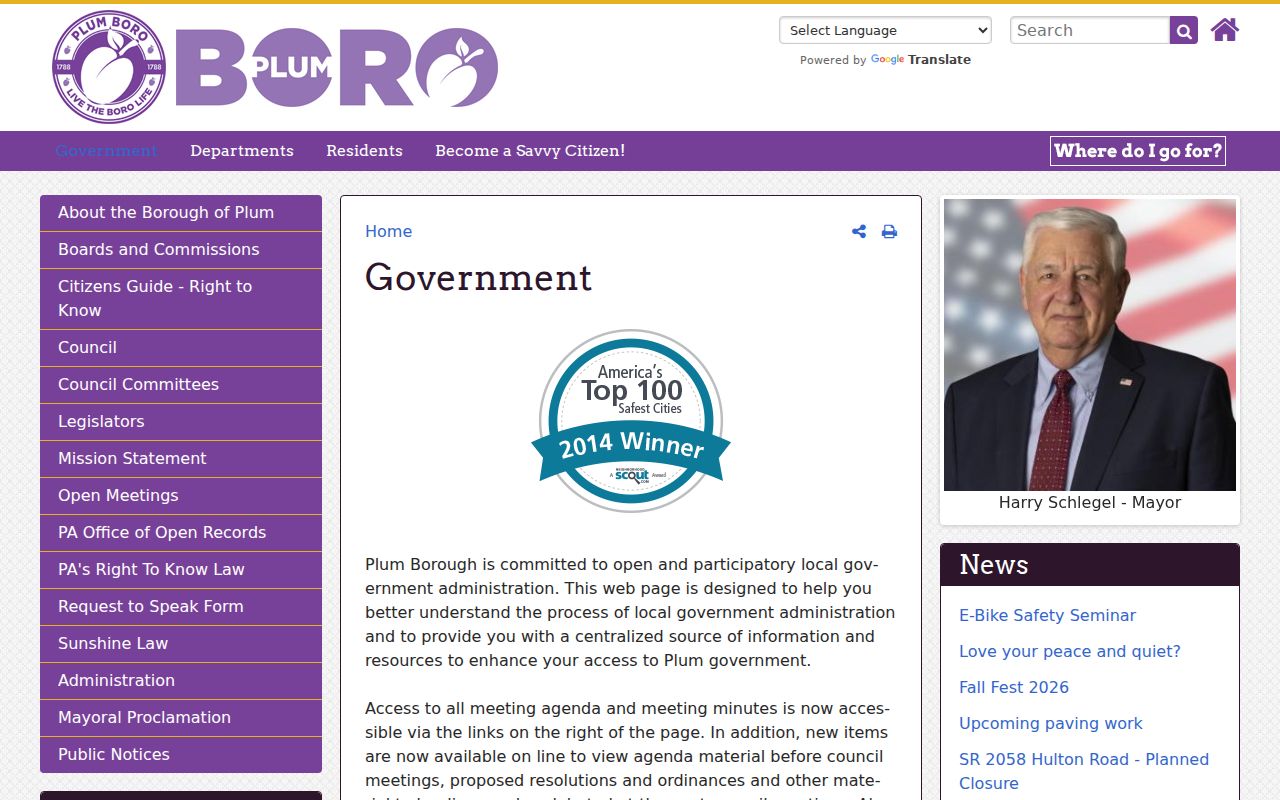
For an existing permit, inspection, zoning, code, map, or minute, request the identifiable record rather than asking the borough to answer a broad research question.
Plum identifies Nikki Lauricia as its open-records officer. A Right-to-Know request may be mailed, emailed, faxed, or delivered in person, and the Borough gives fax 412-793-4061. Include the street number, street spelling, date range, and record category. The stated framework is five business days to grant, deny with a cited basis, or invoke a 30-day extension.
Lawful Plum Address History
House history and family history work best when every record keeps its own limits. A deed identifies transfer parties. A directory shows a dated listing. A census is an area and household snapshot. A property mailing address is where an assessment bill goes, not a verified residence. Protected addresses and nonpublic household information remain outside this research trail.
Lawful use. Use Plum address history for personal, lawful research and documented family or property questions. Do not use a historical lead to harass, track, or harm any living person.
Mark a missing connection as a lead, then seek a custodian record with a date, page, parcel, plan, or legal-description match. That careful rule protects both the historical record and the people connected to it.
Note: A complete timeline distinguishes conveyance parties, dated listings, household snapshots, and municipal actions instead of treating them as interchangeable resident proof.